
Recently, our readers have been asking us this pressing question: Estimated Billing vs. Prepaid Meter—which one is cheaper? So, we have decided to answer this important question in this comprehensive guide. Stay tuned as we go through it together, especially if you have been contemplating whether to continue using estimated billing or switch to a prepaid metering system.
Both prepaid metering and estimated billing systems are used by electricity providers to collect light bills from consumers. While both of them are efficient methods for collecting electricity bills, consumers have been contemplating the one that is cheaper. In all sincerity, some electricity consumers have testified that the prepaid metering system is cheaper but there are also consumers who prefer estimated electricity billings for prepaid meters.
Nevertheless, we are going to weigh them side by side in the course of our discussion to enable you to choose the one that is most suitable for you. However, there are important factors to consider when choosing between estimated billing vs. prepaid meter or vice versa, and we are going to also enumerate those factors in the subsequent sections.
What is Estimated Billing?
Estimated billing is a situation where your electricity provider charges you based on an assumed amount of power they think you’ve used—not the actual reading of your meter. The estimated billing is often used when you don’t have a prepaid or functional postpaid meter, your meter is faulty or inaccessible or when your electricity distribution company (DisCo) prefers a quick calculation instead of an actual meter reading.
Key Features of Estimated Billing
The estimated billing system has the following features:
- You get a monthly bill (postpaid system)
- Charges are based on “average consumption” in your area or customer category
- No control over daily electricity usage
- You pay whether or not you had a constant supply.
What is a Prepaid Meter?
A prepaid meter works like a mobile phone recharge system—you pay for electricity before you use it. You load units (kWh) into your meter using a token or recharge code. When you are using a prepaid meter, you only pay for power you use, no surprise bills—your meter counts down in real time, you can monitor and control your consumption and if you don’t load units, your power goes off
Cost Comparison Between Estimated Billing vs. Prepaid Meter
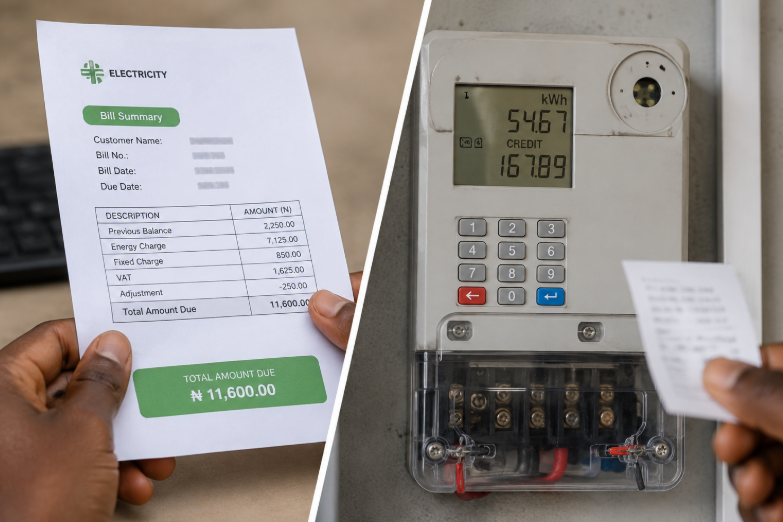
To answer the question of which is cheaper, let’s look at the major differences. We are going to use the table below to compare the two electricity billing systems.
| Feature | Estimated Billing | Prepaid Meter |
| Monthly Cost | Usually higher, often inflated | Usually lower, based on actual usage |
| Control | No control—you pay whatever is billed | Full control—you decide how much to spend |
| Transparency | Low—-bills can be unclear | High—you see your balance in real time |
| Supply vs. Payment | You may pay for power you didn’t get | You pay only for what you use |
| Flexibility | None—you must pay the fixed bill | High—you can load small or large amounts |
Why Estimated Billing is Often More Expensive
In the normal electricity billings, estimated billings are always more expensive than prepaid meters, except for prepaid meter users who are under Band A. let’s see some of the reasons why estimated electricity billings are always more expensive than prepaid meter billings.
1. Overbilling
Sometimes, DisCos use a “one-size-fits-all” approach in billing electricity consumers. This means that they bill households based on average figures that may be higher than their actual consumption
2. No consideration for outages
Another reason why estimated billing is more expensive than prepaid meters is that DisCos don’t normally consider outages; hence, even if you had long blackouts within a month, your bill might remain the same.
3. Hidden inefficiency
The estimated billing may also be more expensive than prepaid meter billing due to hidden inefficiency, like leaks, faults, or power theft in your area that could push your estimated bill higher.
Why Prepaid Meters is Considered Less Expensive
The major reasons why prepaid meters are considered more cost-effective than estimated billing are listed below:
- You only pay for the energy you consume; hence, there are no inflated bills.
- Prepaid meters encourage users to adopt energy-efficient behaviors.
- Prepaid meters are budget-friendly—You can decide how much to spend each month
- There is transparency when using a prepaid meter because you can track daily consumption and adjust accordingly.
Which One Should You Choose?
Now, let’s answer the question properly. The truth of the matter is that a prepaid meter is considered cheaper if you want control, fairness, and potentially lower costs.
However, if your area has a constant power supply and your bill is always low, then you can continue using estimated billing. In addition, if your area is under Band A, it is best to continue using estimated billing because prepaid meter users under Band A pay heavily for their energy usage.